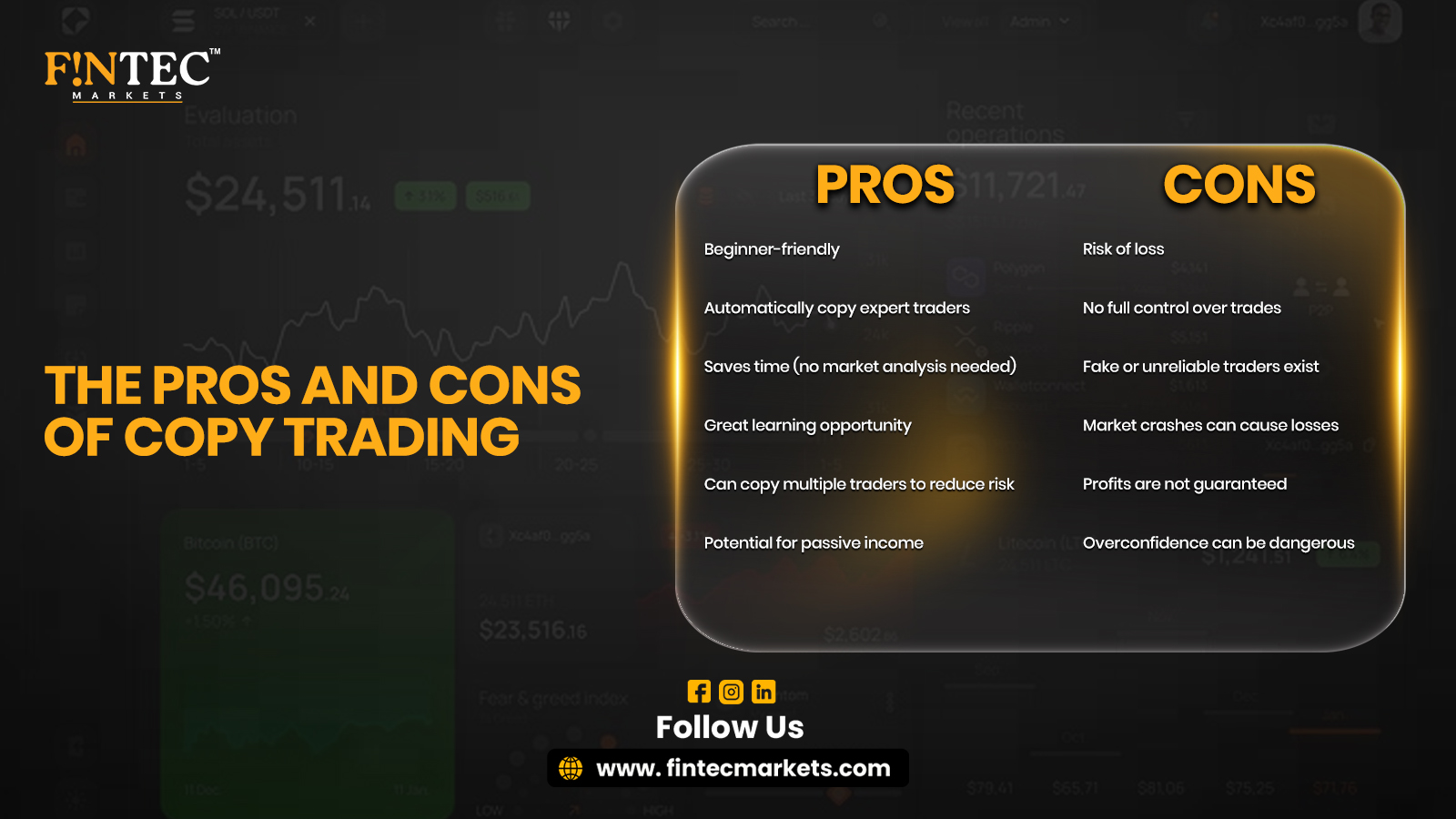
The Pros and Cons of Copy Trading
According to recent market research, the global copy trading platform market reached USD 4.3 billion in 2024 and is projected to grow at a compound annual growth rate (CAGR) of around 19.7% through 2033.
This rapid growth highlights how many retail investors are now choosing to mirror experienced traders rather than trading alone. As the landscape evolves, copy trading offers an appealing route into financial markets, but it also demands a clear understanding of both its advantages and its risks.
What Is Copy Trading?
Copy trading is a type of social trading where investors replicate the trades of experienced traders (often called strategy providers or signal providers). When those traders open or close positions, those actions are mirrored in the investors’ accounts, scaled to their investment size.
The Advantages (Pros)
Accessibility for Beginners
Copy trading lowers the barrier to entry. You don’t need to spend hours analysing charts, studying fundamentals, or mastering advanced strategies. By following an experienced trader, you can participate in financial markets with less direct decision-making.
Built-in Learning Opportunity
Even though you’re copying, you can still observe and learn. You’ll see how the strategy provider handles risk, manages trades, and reacts to market conditions. Thus, it offers a practical education over time.
Time‐Efficiency
For people with limited time, copy trading allows you to stay active in the market without constantly monitoring it yourself. Once set up, your account mirrors trade activity automatically.
Diversification Possibilities
You can follow multiple traders with different styles (e.g., swing, scalping, long-term) and across different assets to spread risk. This can help reduce dependency on a single strategy.
Transparency & Performance Monitoring
Many platforms display detailed statistics about strategy providers, including historical performance and risk metrics. This transparency lets you make more informed choices.
The Disadvantages (Cons)
Market Risk Still Applies
Copying a trader does not remove risk. The markets can move against you just as they can work for you. Past performance is not a guarantee of future results.
Over-Reliance on Others
If you rely purely on someone else’s strategy without understanding it, you may be unprepared when things change. Your learning curve may be limited if you simply follow and don’t engage.
Potential Technical & Platform Risks
Copy trading depends on the platform’s technology, execution speed, and reliability. Any lag, system downtime, or mismatches between the master’s trades and your executed trades can impact outcomes.
Fee Structures & Hidden Costs
Some providers or platforms charge performance fees or extra costs, which can eat into your returns. You must fully understand the fee structure before committing.
Inconsistent Results Among Followers
Even when a strategy provider performs well, followers may not achieve identical results due to differences in timing, capital size, leverage, or transaction timing.
Tips for Safe and Effective Copy Trading
Research your strategy provider thoroughly: Review their track record, drawdown, risk profile, and consistency.
Start small: Begin with a modest allocation and grow only when you’re comfortable.
Diversify across traders and asset classes to reduce dependency on a single strategy or person.
Stay informed: Even though trades are copied automatically, you should monitor performance and make adjustments as needed.
Use a regulated and transparent platform: Ensure the broker or platform you use is reputable and provides the data you need.
Final Thoughts
Copy trading has become a powerful tool for traders who want exposure to financial markets without doing all the heavy lifting themselves. Its popularity, supported by the rapid growth in the market, is a testament to its usefulness. But it’s not a passive guarantee of profits. It still demands diligence, reasonable expectations, and an understanding of the strategy you’re following. If used correctly, copy trading can be a smart addition to your trading toolbox but only if you remain engaged, informed, and prepared for the realities of the markets.
