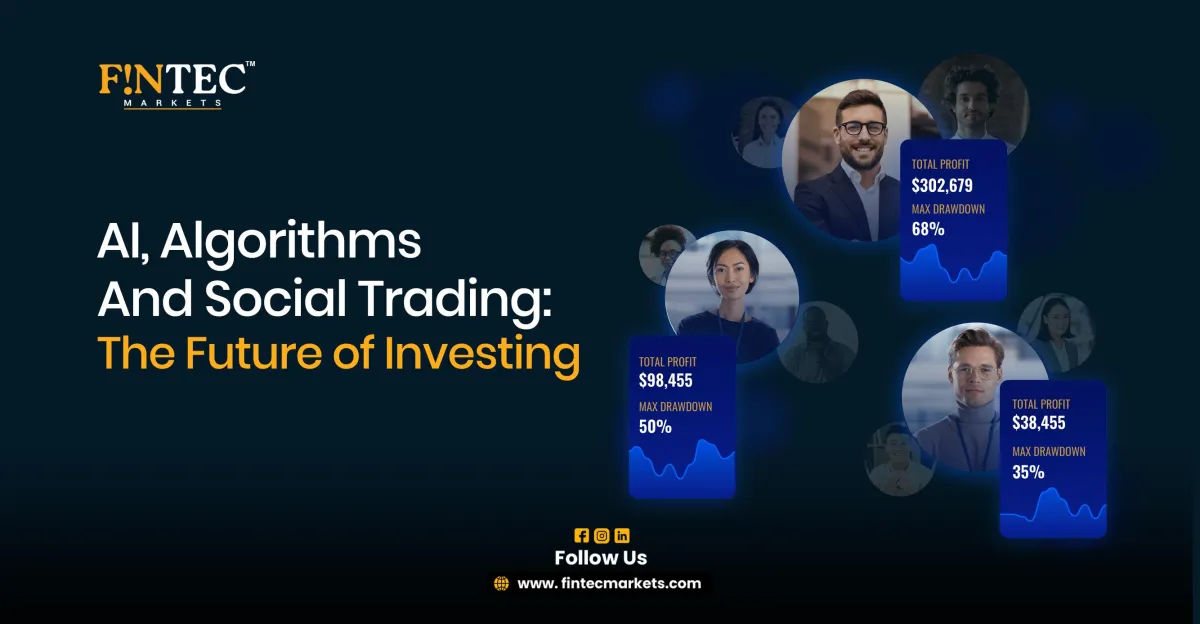
AI, Algorithms, and Social Trading: The Future of Investing
How technology and community are rewriting the rules of wealth-building for everyone
Not long ago, sophisticated investing was a closed room. You needed a Bloomberg terminal, a network of institutional contacts, and research budgets that most individuals could not dream of. The gap between the retail investor and the professional trader was not just financial, it was structural, informational, and deeply entrenched. For most people, the markets were something that happened to them, not something they could meaningfully participate in on equal footing.
That world is dissolving. Quietly, then quickly, a convergence of artificial intelligence, algorithmic tools, and social trading networks has begun dismantling the walls that kept everyday investors on the outside. What once required a hedge fund is now available through an app. What once demanded years of market education can now be supplemented and in some cases replaced by following the verified strategies of experienced traders in real time.
This is not hype. It is a structural shift in how markets are accessed, understood, and participated in. And it is only getting started.
The Rise of Algorithmic Investing
Algorithms have been at the heart of institutional trading for decades. High-frequency trading firms, quantitative hedge funds, and investment banks have long used complex mathematical models to identify opportunities, manage risk, and execute trades at speeds measured in milliseconds. What has changed dramatically in recent years is who has access to these tools.
Today, algorithmic capabilities are embedded in platforms that ordinary investors use every day. These tools analyse price patterns, monitor multiple markets simultaneously, execute trades based on pre-set rules, and do all of it without the emotional interference that causes so many human investors to buy high and sell low. Think of it like GPS navigation versus guessing your way across a city. You could study the map, memorise the roads, and make your best judgement or you could let a system that has processed millions of routes in real time guide you efficiently to your destination. Algorithms do not guarantee you arrive without traffic, but they eliminate a significant category of human error from the journey.
For retail investors, the practical implication is profound: the discipline and consistency that once required years of trading experience to develop can now be codified, automated, and applied at scale. The emotional variable (the panic selling at market dips, the greed-driven overexposure during rallies) is removed from the equation. And as these tools become more sophisticated, they are laying the groundwork for something even more powerful: artificial intelligence that does not just follow rules, but learns.
Algorithms do not eliminate risk but they eliminate an enormous category of very human, very costly mistakes.
How AI Is Changing the Game
If algorithms are the rules, artificial intelligence is the system that writes better rules over time. Machine learning models are now capable of processing a volume and variety of market signals that no human analyst could handle simultaneously: news sentiment across thousands of sources, macroeconomic data releases, historical price correlations, earnings call transcripts, social media activity, and geopolitical signals — all synthesised in real time to inform investment decisions.
This is not science fiction. It is already happening at the consumer level. AI-powered platforms now offer personalized portfolio construction based on an individual's risk tolerance, investment horizon, and financial goals. They flag anomalies in a user's exposure before those anomalies become losses. They surface opportunities that match a specific strategy profile with a precision that was, until recently, the exclusive output of well-funded research teams.
It is important to be clear-eyed here. AI is a tool, not an oracle. It does not predict the future with certainty, and no algorithm eliminates the inherent unpredictability of markets. What AI does exceptionally well is process complexity at scale, reduce the impact of cognitive bias, and surface patterns that humans miss. Used thoughtfully, it is an extraordinary leveller but if used naively, it can create a false sense of certainty that is itself dangerous. The most sophisticated investors understand both sides of that coin and the best platforms are built with that balance in mind. The human layer, it turns out, still matters enormously. Which is exactly where social trading enters the picture.
The Social Trading Revolution
Technology has lowered the barriers to market participation. But knowledge — the lived, experiential understanding of how markets move, how risk compounds, and how strategies perform across different conditions — is not something an algorithm can simply download into a new investor's mind. That gap between access and understanding is where social trading has emerged as a genuinely transformative force.
Social trading allows investors to observe, follow, and automatically replicate the strategies of experienced, verified traders. It is a network built not just on data, but on human expertise made transparent and actionable. A beginner does not need to understand the mechanics of a forex breakout strategy to benefit from one, rather, they need access to a trader whose track record, risk profile, and methodology are clearly displayed and whose trades can be mirrored in their own portfolio automatically.
The parallel to social media is instructive. Before platforms like YouTube and Instagram, creating and distributing content required studios, distribution networks, and gatekeepers. Social media removed those barriers and unleashed a wave of creators who had always had the talent but never had the platform. Social trading is doing precisely the same thing for market participation, both for the followers who gain access to institutional-grade strategies, and for the experienced traders who can now monetise their expertise and build a following without working at a bank.
Social trading democratises market participation the same way social media democratised content creation, by removing the gatekeepers.
This is not passive investing dressed up in new language. It is an active, transparent, community-driven ecosystem where performance is visible, strategies are explainable, and the relationship between follower and strategy provider is built on accountability. And as the technology behind it matures, that ecosystem is becoming significantly more intelligent.
Where It Is All Heading
The next evolution of social trading is already taking shape, and it is defined by personalisation at a scale that was not previously possible. AI-curated trader feeds will match followers not just by return metrics, but by deep compatibility — aligning risk appetite, trading style, asset preference, and even the emotional volatility of a strategy with the psychological profile of the investor following it. The result is a more sustainable, more informed, and more individually appropriate form of portfolio management.
Real-time performance transparency will become the baseline expectation. Investors will demand and platforms will provide granular visibility into not just what a trader is doing, but why, and how that performance holds up across different market conditions. Community-driven market intelligence, where the collective insight of thousands of active traders feeds into smarter signals for everyone, will increasingly supplement and in some cases outperform traditional research.
Perhaps most significantly, the line between investor and trader is blurring in ways that are genuinely positive for financial inclusion. As tools become more intelligent and communities more collaborative, the binary of passive investor versus active trader is giving way to a spectrum of participation where individuals can engage with markets at whatever level of involvement suits their time, knowledge, and appetite. The future of investing is not one-size-fits-all. It is deeply, intelligently personal.
What This Means for You
You do not need to understand the architecture of a machine learning model to benefit from one. You do not need to build your own trading algorithm or spend years decoding candlestick charts. What you need is access to the right platform, the right tools, and the right community of traders whose expertise you can learn from and, if you choose, follow directly.
That access now exists. The technology is mature enough to be genuinely useful, the communities are large enough to be genuinely diverse, and the regulatory frameworks are developing quickly enough to provide meaningful protection. If you have been waiting for the right moment to engage more intelligently with markets, the honest answer is that the infrastructure is ready. What remains is simply the decision to step through the door.
The democratisation of investing is not a distant promise. It is already underway, and the investors who engage with these tools thoughtfully using AI and social networks to become more informed, more consistent, and more strategic are the ones who will look back in five years and understand that they were early. Before we close, let us address some of the questions that come up most often when people begin exploring this space.
Frequently Asked Questions
Q: Is copy trading safe?
A: Copy trading carries the same market risks as any form of investing; returns are never guaranteed, and the value of investments can fall as well as rise. What copy trading does is give you access to the strategies of experienced, verified traders with a transparent track record, so your decisions are more informed. Reputable platforms also provide risk management tools, including the ability to set loss limits and diversify across multiple traders to reduce exposure to any single strategy.
Q: Do I need trading experience to get started?
A: No. One of the core advantages of social trading platforms is that they are designed to be accessible to investors at all levels. Beginners can start by browsing trader profiles, studying performance histories, and following strategies that match their risk appetite without needing to understand the mechanics of every trade being placed. Over time, many users find that following experienced traders is also an education in itself.
Q: How does AI actually help me as an individual investor?
A: AI on modern trading platforms works in several practical ways: it helps personalise trader recommendations based on your risk profile, flags unusual patterns in your portfolio exposure, and surfaces market insights drawn from a far wider range of signals than any individual could monitor. Think of it as a tireless research assistant that processes enormous volumes of data and distills the most relevant information for your specific situation
Q: What makes a good trader to follow on a copy trading platform?
A: Look beyond headline return figures. Consistency over time matters more than a single impressive month. Assess the trader's drawdown history, how much did they lose during difficult market periods, and how did they recover? Consider how transparent they are about their strategy and methodology. A strong trader to follow is one whose risk profile aligns with yours, whose performance holds up across different market conditions, and who communicates openly with their followers.
Q: Can I stop copying a trader at any time?
A: Yes. Reputable copy trading platforms give you full control to pause or stop copying any trader at any time, and to close out positions independently if needed. You are never locked into a strategy. This flexibility is an important part of responsible platform design. This means your portfolio remains yours, and you retain the ability to make adjustments as your needs or market conditions change.
Q: Is algorithmic trading the same as copy trading?
A: Not exactly, though the two increasingly overlap. Algorithmic trading refers to trades executed automatically based on pre-programmed rules or AI-driven models. Copy trading specifically involves mirroring the trades of a human trader whose strategy you have chosen to follow. Many modern platforms now blend both. They use AI to recommend traders, optimize portfolio allocation across multiple strategies, and execute copy trades with the speed and precision of an algorithm. The result is a more intelligent, more responsive form of social investing.
Final Thoughts
The story of investing has always been, at its core, a story about access. For most of market history, that access was rationed — by wealth, by education, by geography, by the connections you were born into. What AI, algorithmic tools, and social trading have done, collectively and rapidly, is begin to dismantle that rationing system.
The tools are not perfect. Markets remain unpredictable, risk cannot be engineered away, and the responsibility to invest thoughtfully has not changed. But the gap between the institutional investor and the individual has never been narrower. The community of knowledge that was once locked inside trading floors is now open and growing. The technology that once required millions in infrastructure is now accessible through a screen in your pocket.
What you do with that access is, as always, entirely up to you. But for the first time in the history of financial markets, the choice is genuinely yours to make.
Ready to Trade Smarter?
The future of investing is built on access, transparency, and the wisdom of experienced human traders, and that’s exactly what Fintec Markets was built to deliver. We, at Fintec markets connects you directly with verified, skilled traders whose strategies you can follow in real time
→ Explore Top-Performing Traders on Our Platform
